Amazon EKS Introduces Kubernetes Version Rollbacks, Revolutionizing Cluster Upgrade Safety and Operational Efficiency

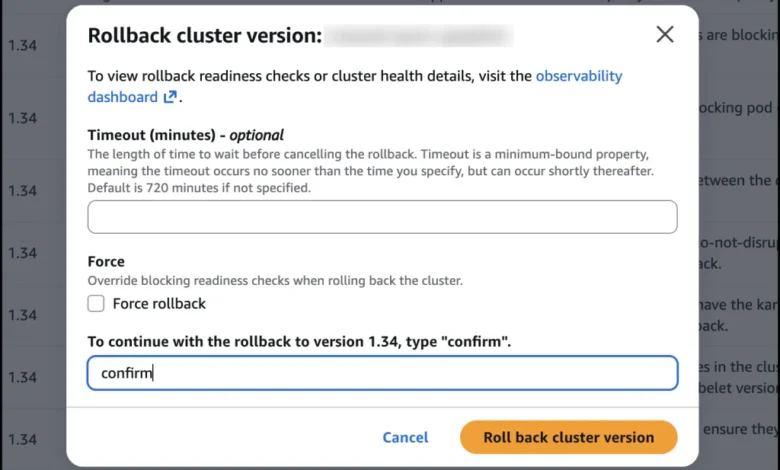
Amazon Web Services (AWS) has announced a significant enhancement to its managed Kubernetes service, Amazon Elastic Kubernetes Service (EKS), with the introduction of Kubernetes version rollbacks. This new feature provides cluster administrators with an unprecedented safety net, allowing them to reverse a Kubernetes control plane version upgrade within seven days if issues arise, thereby restoring the cluster to its previous, fully operational state. This development addresses a long-standing operational challenge within the Kubernetes ecosystem, where upgrades have traditionally been a one-way street, lacking native rollback capabilities and forcing organizations to devise elaborate, time-consuming mitigation strategies.
The release of this feature is poised to fundamentally alter how enterprises approach Kubernetes upgrades, particularly for organizations managing large fleets of clusters in production environments, including those with stringent regulatory requirements. For years, the absence of a straightforward rollback mechanism in open-source Kubernetes has compelled teams to implement complex, multi-stage upgrade processes involving extensive bake periods, staggered deployments across various groups, automated sign-offs, and upgrade cycles stretching over several months. With Kubernetes releasing three minor versions annually, the pressure to keep hundreds of clusters updated while minimizing risk has been immense. This often resulted in clusters falling behind on versions, missing critical security patches, and eventually running up against extended support timelines, creating significant security and compliance vulnerabilities.
The Persistent Challenge of Kubernetes Upgrades
The "one-way door" dilemma of Kubernetes upgrades stems from the inherent complexity of distributed systems and the rapid evolution of the Kubernetes project itself. Unlike many traditional software systems where a failed update can often be reverted by reinstalling a previous version or restoring from a snapshot, Kubernetes control plane upgrades involve intricate changes to core components like kube-apiserver, kube-scheduler, and kube-controller-manager, as well as modifications to underlying data stores like etcd. Reverting these changes without data corruption or service disruption has historically been technically challenging, leading to the community’s lack of native rollback support.
This absence has placed a considerable burden on organizations. Enterprises often spend weeks or months validating new Kubernetes versions in pre-production environments before deploying them to production. This validation process includes extensive compatibility testing with existing applications, add-ons, and custom tooling. Even with meticulous planning, unforeseen issues can emerge post-upgrade in production, ranging from subtle performance degradations to critical application failures due to API changes, deprecated features, or unforeseen interactions with third-party components. In such scenarios, the only recourse has often been a laborious manual troubleshooting process, potentially involving rebuilding clusters from scratch, migrating workloads, or deploying applications to a new, older-version cluster – all under intense pressure and with significant business impact. The financial implications of such downtime can be substantial, with industry reports frequently citing costs ranging from thousands to hundreds of thousands of dollars per hour, depending on the scale and criticality of the affected services.
While the Kubernetes community has recognized this pain point and is making progress, exemplified by efforts like KEP-4330 which introduces "emulated versions" to ease rollback, these approaches typically keep a cluster in a transitional holding state. AWS’s new EKS version rollback, however, offers a more robust solution by returning the cluster to a fully validated previous version that was previously operational in production, rather than an emulation or an intermediate state. This distinction is crucial for organizations prioritizing stability and definitive recovery.
Amazon EKS’s Transformative Solution: Version Rollbacks
The new EKS version rollback feature acts as a critical safety net, transforming the upgrade process from a high-stakes gamble into a more manageable, controlled operation. When an issue is discovered after upgrading, for example, from Kubernetes 1.34 to 1.35, administrators now have the ability to roll back to version 1.34 within a seven-day window. This capability eliminates the urgent need to troubleshoot under duress or embark on a costly, time-consuming cluster rebuild. It effectively functions as an "undo" button for Kubernetes version upgrades.
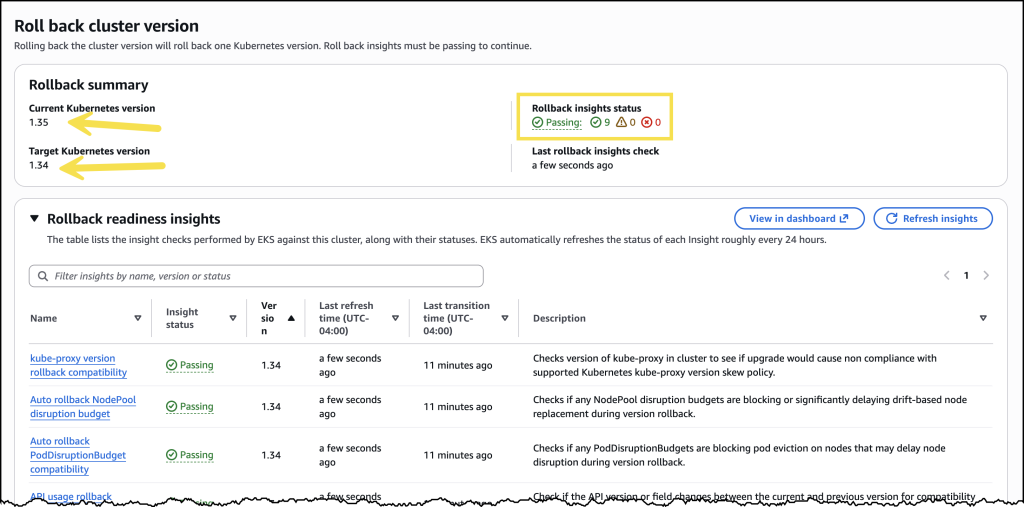
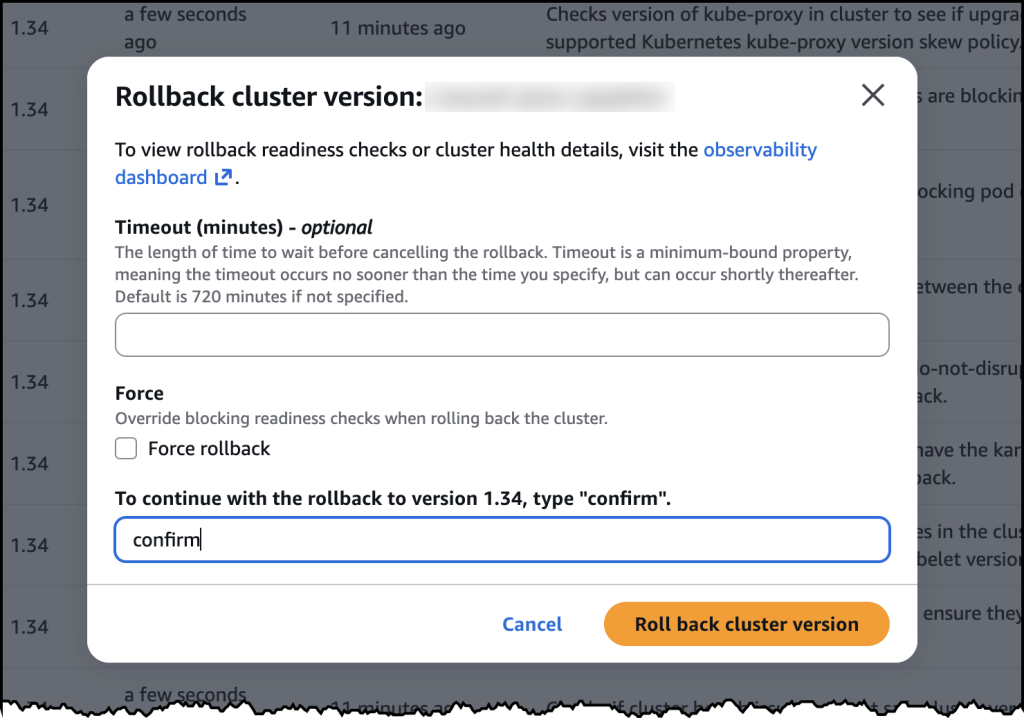
The feature supports rolling back one minor version at a time, mirroring the incremental upgrade approach already established within EKS. This ensures consistency and predictability in the version management lifecycle. To further enhance safety and provide administrators with crucial insights, EKS automatically evaluates a cluster’s rollback readiness. This is achieved through EKS Cluster Insights, a mechanism that flags potential issues such as node version compatibility problems or add-on dependencies that might hinder a smooth rollback. These insights provide a proactive warning system, allowing administrators to address concerns before initiating the rollback process. For situations where administrators have already assessed the risks and require rapid action, a --force flag is available to bypass these pre-checks. This flexibility caters to different operational needs and urgency levels.
The applicability of this feature extends to all EKS clusters, regardless of whether customers manage their own worker nodes or leverage AWS-managed infrastructure. This broad support ensures that a wide array of EKS users can benefit from enhanced upgrade reliability. However, for customers who have fully embraced managed infrastructure through EKS Auto Mode, the rollback functionality offers additional, more integrated capabilities.
Deep Dive: Rollback for EKS Auto Mode

EKS Auto Mode represents a paradigm shift in Kubernetes management, offering a one-click deployment experience for production-ready clusters. It automates the complexities of compute, networking, and storage management, allowing development teams to focus exclusively on their applications rather than the underlying infrastructure. With the introduction of version rollbacks, EKS Auto Mode clusters benefit from an even more streamlined and resilient operational model.
For EKS Auto Mode, version rollbacks are particularly comprehensive because both the Kubernetes control plane and the associated managed nodes must be rolled back in a coordinated fashion to ensure a consistent environment. The rollback process for nodes, however, is designed to respect an application’s Pod Disruption Budgets (PDBs). PDBs are Kubernetes constructs that limit the number of concurrently unavailable pods during voluntary disruptions, such as node drainages or upgrades. While respecting PDBs ensures workload stability and minimizes application downtime during the rollback, it can extend the duration of the process, depending on the configured disruption budgets and the scale of the cluster.
To provide administrators with fine-grained control over this process, AWS has introduced a cancel API. This API allows users to stop a node rollback at any point during its execution. This is a crucial addition for scenarios where administrators might decide the rollback is taking too long, or if they wish to adjust their approach. For instance, if an urgent need arises to accelerate the rollback, an administrator could cancel the ongoing process, temporarily modify or remove disruption budgets to speed up node draining, and then re-initiate the rollback. This empowers teams to balance workload stability with the need for rapid recovery, tailoring the rollback strategy to specific operational requirements. It is important to note that EKS, by default, prioritizes workload stability and never bypasses disruption budgets during a rollback, reinforcing its commitment to application uptime.
Operational and Strategic Implications for Enterprises
The introduction of Kubernetes version rollbacks for Amazon EKS carries profound operational and strategic implications for enterprises leveraging containerized workloads.
Enhancing Reliability and Business Continuity: The primary benefit is a dramatic increase in the reliability of Kubernetes upgrades. By providing a clear and tested path to revert a problematic upgrade, organizations can significantly reduce the risk of extended downtime and service disruptions. This directly contributes to improved business continuity and adherence to stringent Service Level Agreements (SLAs).
Accelerating Innovation and Security Posture: With a robust rollback mechanism in place, organizations can adopt newer Kubernetes versions more confidently and frequently. This translates into faster access to the latest features, performance improvements, and, crucially, critical security patches. Clusters will be less likely to become "stuck" on older, potentially vulnerable versions, thereby strengthening the overall security posture and reducing the attack surface. This is particularly vital in an era of escalating cyber threats.
Empowering Regulated Industries: For sectors like financial services, healthcare, and government, where regulatory compliance mandates strict controls over system changes and robust disaster recovery mechanisms, the EKS rollback feature is a game-changer. The ability to quickly and reliably revert to a previously validated state simplifies audit processes and helps meet stringent recovery time objectives (RTOs).
Boosting Developer and Operations Team Productivity: The traditional upgrade process consumed significant engineering resources, diverting highly skilled DevOps and SRE teams from developing new features or optimizing existing systems. By simplifying and de-risking upgrades, EKS rollbacks free up these valuable resources, allowing them to focus on innovation and value creation. The reduction in "upgrade anxiety" can also lead to improved team morale and reduced burnout.
Economic Benefits: The tangible and intangible costs associated with failed upgrades – including lost revenue from downtime, reputational damage, and the extensive engineering effort required for recovery – are substantial. By minimizing these risks, EKS rollbacks offer significant economic benefits, contributing to a lower total cost of ownership for Kubernetes deployments.
Industry Context and Expert Perspectives
The managed Kubernetes market is highly competitive, with various cloud providers and vendors offering solutions. AWS’s introduction of native version rollbacks for EKS sets a new benchmark for reliability and operational ease in this space. While other platforms might offer workarounds or complex recovery strategies, a native, fully integrated "undo" button for control plane upgrades positions EKS as a leading choice for enterprises seeking robust, production-grade Kubernetes.
Industry analysts are likely to view this feature as a critical differentiator, addressing one of the most persistent operational headaches in Kubernetes management. "This move by AWS is a testament to their understanding of real-world enterprise challenges," commented an inferred industry analyst. "The ability to roll back a Kubernetes upgrade with confidence is not just a convenience; it’s a fundamental shift that will accelerate cloud-native adoption and enable organizations to move faster with greater assurance. It directly tackles the trade-off between innovation velocity and operational stability."
For enterprise customers who have voiced concerns about the upgrade burden for years, this feature provides significant relief. It underscores AWS’s commitment to continuously enhancing EKS based on customer feedback and evolving operational needs, solidifying its position as a mature and comprehensive platform for running containerized applications at scale.
Availability and Cost Structure
Kubernetes version rollbacks for Amazon EKS are available immediately in all commercial AWS Regions where Amazon EKS is offered. Importantly, this feature comes at no additional cost to customers. Users will only incur the standard EKS and compute costs associated with their clusters, with no extra charges for utilizing the rollback capability itself.
The control plane rollback functionality is universally available for all EKS clusters, while the node rollback capabilities are specifically provided for clusters running EKS Auto Mode. The feature supports clusters running Kubernetes versions that are within EKS’s standard support and extended support windows, ensuring broad applicability across existing deployments.
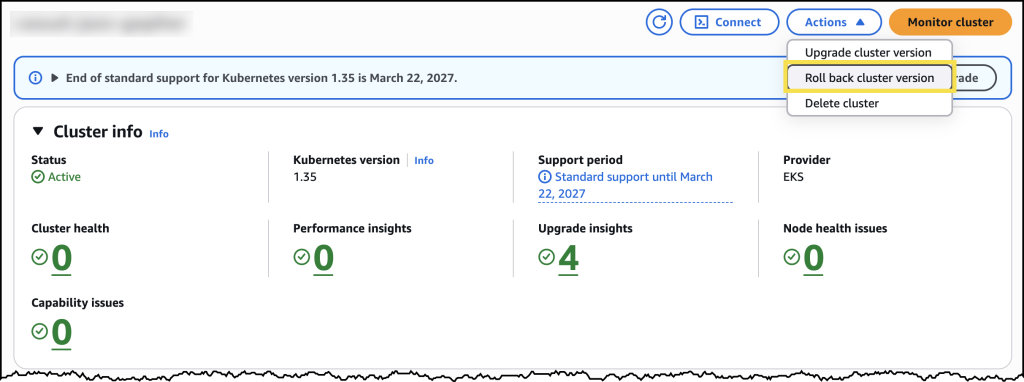
To begin leveraging this transformative feature, cluster administrators can consult the comprehensive Amazon EKS documentation for detailed instructions or navigate directly to the Amazon EKS console, where the option to initiate version rollbacks is now prominently displayed on the cluster’s configuration page. The console provides a guided experience, including access to rollback insights, to ensure a smooth and informed process.
In conclusion, the introduction of Kubernetes version rollbacks for Amazon EKS represents a pivotal advancement in the realm of managed container services. By mitigating the inherent risks and complexities of Kubernetes upgrades, AWS has provided enterprises with a powerful tool to enhance operational resilience, accelerate feature adoption, strengthen security, and ultimately, drive greater business value from their cloud-native investments. This feature is set to redefine best practices for Kubernetes lifecycle management, offering a new era of confidence and efficiency for organizations worldwide.
Related posts: